



Gun Crime Reduction Strategies: What’s Working?
July 23, 2014
Gun violence exacts an incredible toll in communities throughout the United States. Every year, more than 11,000 individuals are murdered by firearms and another 75,000 are treated at hospitals for nonfatal gunshot wounds1. While media tend to focus on mass shootings, the most common criminal gun violence occurs daily and involves gang members, violent youth and others involved in crime. As the front line of defense, local police departments are poised to respond but the question remains: can police effectively reduce and prevent gun violence? Four experts set out to answer this question.
Working through the Bureau of Justice Assistance Smart Policing Initiatives (SPI), a project that links local researchers with their respective police departments to experimentally assess law enforcement interventions, Anthony A. Braga, Daniel W. Webster, and Michael D. White, nationally respected criminology researchers and myself, an SPI Subject Matter Expert, assessed whether gun crime reduction strategies across the country were working.
More than a quarter of the SPI-funded police agencies nationwide (nine of 35 initiatives) targeted gun violence as the focus of their strategies. We examined these nine SPI sites and looked at evidence-based data on gun violence reduction from research conducted in sites in addition to findings from other relevant research. Here’s what we found:
- Few Individuals Committing Many Crimes – Much of the devastating toll of urban gun violence can be linked to a small number of high-rate offenders committing shootings at specific places and times.
- Focus on People, Places and Times- Current evidence suggests police should focus gun violence prevention actions on the people, places and times posing the highest risks to public safety. This risk-focused approach is the guiding principle for Smart Policing strategies.
- Pulling Levers has an Impact – A recent review of focused deterrence strategies (also known as pulling levers) such as offender call-ins found these interventions were associated with significant reductions in gun violence.
While all nine SPI sites used the risk-focused approach to address gun violence, their uses of the strategy varied significantly depending on the local context: Boston used a problem-oriented, hot spots strategy; Baltimore used a combination of targeted enforcement, focused deterrence and an innovative gun offender registry; and Los Angeles used a blended targeted offender/hot spots strategy with enhanced crime intelligence. The strategies used fell into five categories:
- targeting persistent gun violence hot spots,
- targeting prolific offenders in persistent hot spots,
- employing new technologies and advanced crime analysis,
- engaging a wide range of collaborative partners, and
- conducting advanced problem analysis.
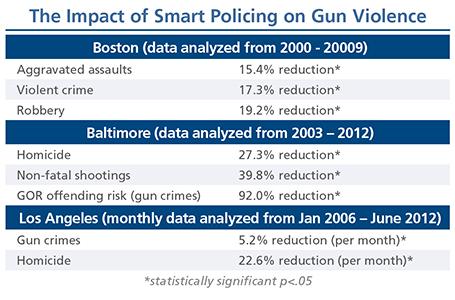
Though many SPI projects are ongoing, several sites produced impressive results indicating their interventions have effectively reduced gun violence. For example, Boston, Baltimore and Los Angeles police achieved double-digit percentage reductions in violent crime and shootings (see chart below).
Across the country, other targeted approaches – utilizing advanced crime analysis and engaging a wide-range of partners – are being evaluated to determine their effectiveness as a gun crime reduction strategy.
These findings and more are detailed in an SPI report titled “SMART Approaches to Addressing Gun Violence: Smart Policing Initiative Spotlight on Evidence-Based Strategies and Impacts.” Police executives, local decision makers, community members, and others concerned with gun violence will find this report helpful, even instructive, as they seek new and more effective ways to reduce gun violence, improve public safety and save lives.
For more information and to view the full report visit www.smartpolicinginitiative.com/tta/spotlight/gun-violence-spotlight.
____________________________________________________________________________
1 National Center for Injury Control and Prevention. Fatal Injury Reports. Web-based Injury Statistics Query and Analysis System (WISQARS).Accessed October 1, 2013.

 FAQs
FAQs Request Assistance
 Email Us
 Submit Your Success Story